
E-raze: Re-defining, Re-contextualising, Re-imagining.
- Oct 9, 2022
- 3 min read
To open this blog, I thought it would be a good idea to address how I chose the blog's title. “E-Raze” is inspired by the structure of Mark Fisher’s famous blog’s title K-Punk and David Lynch’s seminal work Eraserhead.
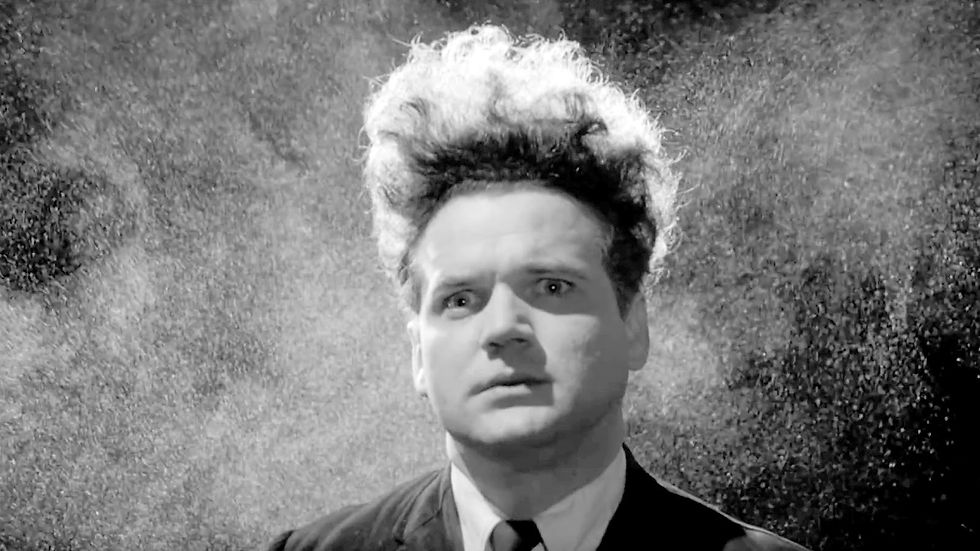
Lynch, Eraserhead (1997)
In the book Lynch on Lynch, the director says
I look at the world and I see absurdity all around me. People do strange things constantly, to the point that, for the most part, we manage not to see it. That's why I love coffee shops and public places—I mean, they're all out there.
Anyone familiar with Lynch’s work won’t be surprised at how his mind filters the world into a menagerie of madness. And this is something perfectly encapsulated in Eraserhead. Throughout the film, even the most banal and insignificant details of daily life are zeroed in on and twisted into moments of disturbance, malaise, and melancholy. As an unpopular post on the subreddit shower_thoughts states, “[e]verything looks weird if you look at it long enough.”
For me, this statement contains huge, albeit likely accidental, philosophical implications. To condense my thoughts surrounding it for the sake of expediency, the “weird,” in this sentence, is a gateway into reality as hidden behind our ongoing internal narratives of what the world is and what things mean. Something probably everyone has experienced is the breakdown of a word into nonsensical noise. Have you ever said a word so many times that you start to question if it is even a word? That’s exactly what I’m talking about—when we laser-focus on something, that thing stops making sense. It makes us feel uncomfortable to have the meaning of that thing erased. Words are “signifiers”; a sound and/or image that identifies a thing. There is no inherent reason why a rose, for example, must be called a “rose.” And, what’s more, there is no inherent reason why a rose must be associated with romance, socialism, Yorkshire, and so on. There may be historically contingent reasons for these associations, but my main point is that there is nothing intrinsic within the object “rose” that warrants its name nor its socially constructed meanings.
So, weird things go against our understanding of the world as constituted by an order of norms. In other words, something is weird when we cannot fully comprehend it, since the way we come to comprehend the world is a process of attaching meaning to objects, situations, ourselves, and so on. And, as I’ve already stated, it is my contention that the weird is an entryway into a reality devoid of the meaning we attach to things. I’ve often been told that some of the “weird” music I listen to is actually “just noise.” But isn’t all music, in reality, “just noise”? When I listen to music I’m aware of the layers; timbre, pitch, melody, and so on. But these are, essentially, just meanings I am attaching to noises contained within soundwaves. So the people I often brush off as having no appreciation for good music actually hear it for what it is—noise.
A person might be a “weirdo” if they rebel against the social norms we conceive of as retaining the fabric of our society. An artwork might be weird if it challenges our perception of what art is. A circumstance might be weird if it throws someone off (what they perceive to be) their life’s course.
That essentially sums up my motivations and personal interests. What lies behind the filter of meaning we use to operate in a society? Why do we think the things we think? What is the point of anything? A part of the title of this blog is inspired by a, perhaps cynical, motivation to “erase” these constructions of meaning. I should mention that I am not alone in this endeavour, having taken much of my inspiration from the likes of Slavoj Žižek, Michel Foucault, and Adam Curtis. It is my hope that starting this blog will be my personal route to stripping back these layers of reality. It’ll be a route with several detours, but an exciting exploration nonetheless.
But I should also note that I am not a complete nihilist, in the sense that I am not opposed to attaching meaning to things. Even if I did want to rid the world of meaning and have everyone perceive their surroundings as just a bunch of interacting particles, I still wouldn’t believe this project to be feasible. The problem is, we cannot help but create meaning. It is what fundamentally makes us human; the ability to describe our experiences and to understand our place in the world is inextricably linked to the meanings we have created and will continue to create. In other words, “meaning,” however misguided it might be, is, fundamentally—to use a highly contentious word—good.
Comments